If you have been researching paint protection for your car, you have probably run into the same debate everyone in Sharjah is having right now: graphene coating vs ceramic coating. Both promise a glossy finish, both claim to fight off UAE heat, and both are marketed as the “ultimate” protection. So which one actually deserves space on your car’s paint?
At Alfaan Auto Care, we have applied both coatings on everything from daily-driven sedans to Lamborghinis and Rolls-Royces rolling through our Industrial Area 4 garage. This guide breaks down the real difference between graphene coating and ceramic coating, specifically for Sharjah’s climate, so you can make a decision based on facts rather than marketing claims.
What Is Graphene Coating and Ceramic Coating
Ceramic coating is a liquid polymer made mostly of silicon dioxide (SiO2). Once cured, it forms a hard, glass-like layer bonded to your car’s clear coat. It has been the gold standard in paint protection for over a decade, prized for its scratch resistance, UV blocking, and hydrophobic (water-repelling) properties.
Graphene coating is the newer evolution. It uses the same ceramic base but infuses it with graphene, a single layer of carbon atoms known for being one of the strongest and most thermally conductive materials on earth. The result is a coating that behaves like ceramic but with added flexibility, faster water sheeting, and better heat dissipation.
Both coatings sit on top of your paint, chemically bond to the clear coat, and are meant to replace old-fashioned wax, which typically breaks down within weeks under UAE sun.
Why This Comparison Matters for Sharjah Car Owners
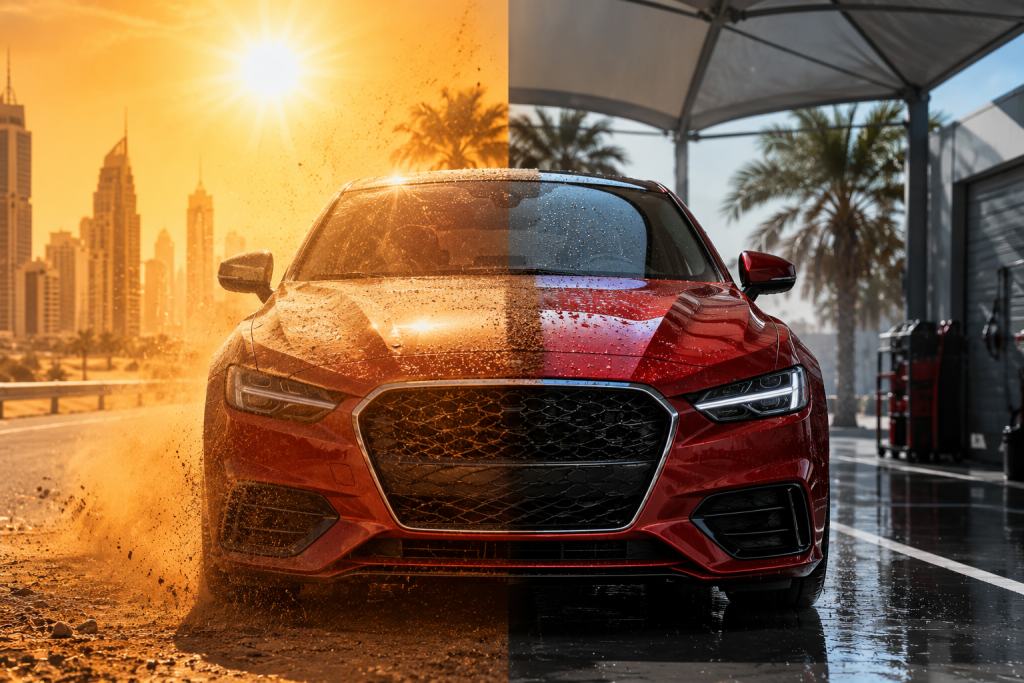
Sharjah’s climate is not gentle on vehicles. Summer surface temperatures on a parked car can exceed 70 to 80 degrees Celsius, UV index levels stay high almost year-round, and fine desert sand works its way into every wash cycle. Add in salty coastal air near the creek areas and you have a combination that accelerates paint oxidation, fading, and swirl marks faster than in almost any other region.
This is exactly why the graphene vs ceramic debate matters more here than it does in cooler markets. A coating that performs well in Europe or North America may not hold up the same way once it is baked daily under Gulf sun. Choosing the wrong protection means redoing the job, and paying for it, within a year or two.
Key Benefits of Each Coating
Ceramic Coating Benefits
- Strong scratch and chemical resistance for daily driving
- Deep, glossy finish that enhances paint depth
- Proven track record with predictable results
- More affordable than graphene, making it accessible for daily drivers
- Effective UV protection that slows down paint fading
Graphene Coating Benefits
- Superior heat dissipation because graphene conducts and releases heat instead of trapping it
- Faster, sharper water beading and sheeting, which means less water spotting after rain or sprinkler exposure
- Higher resistance to hard water stains, a common issue with Sharjah’s mineral-heavy tap water
- Slicker surface feel that resists dust adhesion, useful during sandstorm season
- Slightly more flexible finish that shows fewer micro-marring effects over time
In short, ceramic gives you dependable, budget-friendly protection. Graphene gives you an upgraded version built specifically to handle extreme heat, which is precisely what Sharjah throws at your car for eight months of the year.
Common Problems and Challenges With Coatings
Many car owners in Sharjah run into the same issues, regardless of which coating they choose:
Poor surface preparation. If the paint is not properly decontaminated, clayed, and polished before coating, both graphene and ceramic will bond to trapped dirt and imperfections instead of clean paint. This shortens the life of the coating dramatically.
Unrealistic expectations on durability. Coatings are not “forever” solutions. Ceramic coatings typically last two to three years with proper care, while quality graphene coatings can last three to five years. Both require maintenance washes and occasional topper products to maintain performance.
DIY application in extreme heat. Applying either coating outdoors in Sharjah’s midday sun leads to flash-curing, streaking, and uneven bonding. This is one of the most common mistakes we see when correcting botched at-home applications.
Skipping paint correction. Coating over swirl marks, light scratches, or oxidation locks those imperfections under a hard layer that is difficult to remove later. Correction should always come first.
Important Factors to Consider Before Choosing
Before deciding between graphene and ceramic, think about these factors:
How long you plan to keep the car. If you are keeping your vehicle for three years or less, a quality ceramic coating is often sufficient and more cost-effective.
Your parking situation. If your car sits outdoors under direct sun most of the day, graphene’s heat-dissipating property becomes far more valuable than it would be for a garage-kept vehicle.
Budget versus long-term value. Graphene coating carries a higher upfront cost but tends to reduce the frequency of maintenance detailing over its lifespan, which can offset the price difference.
Paint condition at the time of application. Older paint with existing swirl marks needs correction first. This affects total cost regardless of which coating you choose.
Vehicle type and resale goals. Luxury and exotic car owners planning to maintain resale value tend to lean toward graphene for its added gloss depth and heat resistance, while daily-driver owners often find ceramic perfectly adequate.
Best Practices and Expert Recommendations
After years of coating everything from BMWs to Ferraris in Sharjah’s climate, here is what we recommend:
- Always start with a full paint decontamination and correction, regardless of coating choice. This is non-negotiable for long-term results.
- If your car is parked outdoors most of the day, prioritize graphene for its thermal performance.
- If you are on a tighter budget or driving a daily commuter, a professional-grade ceramic coating still delivers excellent protection at a lower cost.
- Consider a hybrid approach: a ceramic base coat with a graphene spray topper. This combines ceramic’s proven adhesion with graphene’s surface-level heat and water benefits, an approach several premium studios in the UAE are now adopting.
- Maintain the coating with pH-neutral shampoo and the two-bucket wash method. Harsh detergents strip both coatings prematurely.
- Reapply a maintenance topper every six to twelve months to extend the life of either coating in Sharjah’s climate.
How Professional Application Makes the Difference
Coating application is not simply “spray and wipe.” The process requires a controlled environment, correct paint preparation, precise product curing times, and experience reading how the coating is bonding in real time. In Sharjah’s heat and dust, even a small mistake, like applying coating in direct sunlight or missing a decontamination step, can cause streaking, high spots, or premature failure.
Professional detailers also carry the tools to properly correct paint before coating, something a home application almost never includes. This is the difference between a coating that lasts two years and one that fails within months.
Why Choose Alfaan Auto Care
Alfaan Auto Care has spent the last five years earning the trust of over 500 customers across Sharjah, including owners of Lamborghinis, Ferraris, Bentleys, Rolls-Royces, and everyday daily drivers. Our garage in Industrial Area 4 is set up specifically for the demands of UAE paint protection work, from controlled application conditions to premium-grade ceramic and graphene products built to handle extreme heat and UV exposure.
We do not push one coating over the other to upsell you. We assess your vehicle, your parking situation, your budget, and how long you plan to keep the car, then recommend the option that actually makes sense for you. That honesty is a big part of why our customers keep coming back and referring friends.
Our Service Process
- Vehicle Inspection – We assess your paint condition, existing swirl marks, and overall finish before recommending a coating.
- Wash and Decontamination – A full chemical decontamination and clay bar treatment removes embedded dirt, tar, and iron particles.
- Paint Correction – Machine polishing removes swirl marks and light scratches, giving the coating a clean, flawless base.
- Coating Application – Ceramic or graphene coating is applied in a controlled environment, panel by panel, for even bonding.
- Curing Period – The car is left to cure under proper conditions before it is safe to expose to water or dust.
- Final Inspection and Handover – We walk you through maintenance tips specific to the coating you chose, so it lasts as long as possible.
Frequently Asked Questions
Is graphene coating really better than ceramic coating in the UAE? Graphene generally performs better in extreme heat because it dissipates heat instead of trapping it, which matters in Sharjah’s climate. Ceramic coating is still a strong, reliable option, especially for owners on a budget or keeping their car for a shorter period.
How long does ceramic coating last in Sharjah’s heat? A professionally applied ceramic coating typically lasts two to three years in Sharjah, depending on parking conditions, wash frequency, and maintenance care.
How long does graphene coating last compared to ceramic? Quality graphene coatings can last three to five years with proper maintenance, generally outlasting standard ceramic coatings by one to two years.
Can I apply graphene coating over an existing ceramic coating? Yes. Many detailing studios in the UAE now apply graphene spray toppers over an existing ceramic base to combine the strengths of both, a hybrid approach we also offer at Alfaan Auto Care.
Does coating replace the need for regular car washing? No. Coatings reduce dirt adhesion and make washing easier, but your car still needs regular washing with pH-neutral products to maintain the coating’s performance and appearance.
Which coating is better for a new car straight from the dealership? Both work well on new paint since there is no correction needed. The choice then comes down to your budget and how long you intend to keep the car, factors we help you weigh during your consultation.
Conclusion
There is no single “better” coating that fits every car owner in Sharjah. Ceramic coating remains a dependable, cost-effective way to protect your paint from UV rays, chemical stains, and daily wear. Graphene coating takes that protection further with better heat management and water resistance, making it especially valuable if your car spends most of its time parked outdoors under Sharjah’s sun.
What matters most is proper paint preparation and professional application, regardless of which coating you choose. A rushed or DIY job will underperform even the best product on the market.
Get Expert Advice for Your Car
Not sure which coating fits your vehicle and budget? Our team at Alfaan Auto Care will inspect your car, walk you through the honest pros and cons, and recommend the protection that actually makes sense for how and where you drive in Sharjah.
Call us at +971528105044 or message us on WhatsApp to book your consultation and get your car protected the right way.