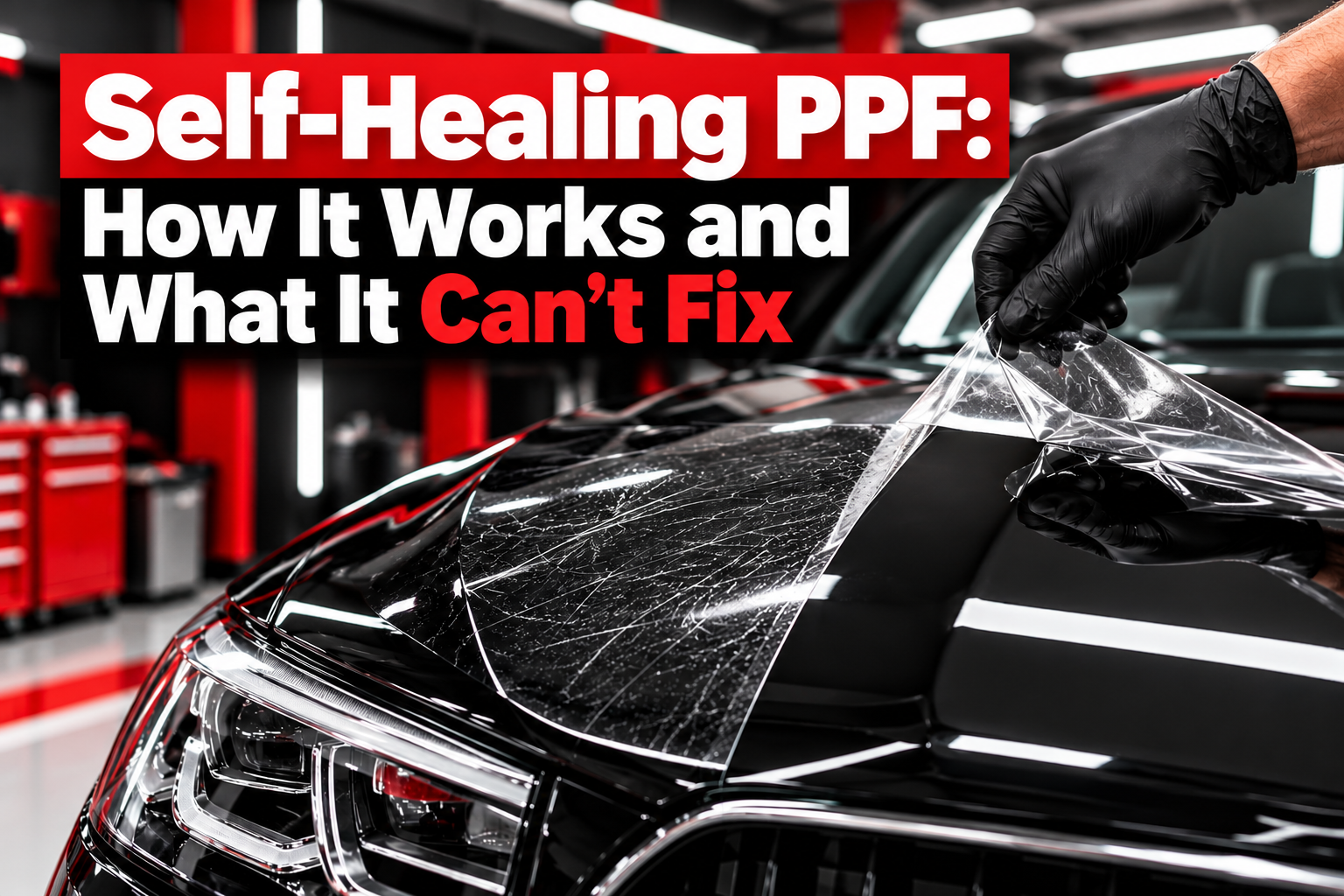
Quick Answer: Self-healing PPF is a clear polyurethane (TPU) film with a special top coat that “remembers” its shape. When it warms up, from sunlight or warm water, light scratches and swirl marks in the film flatten out on their own, usually within minutes to a few hours. It does not fix deep cuts that go through the film, damage to the paint underneath, or low-quality films with no healing coat. In Sharjah’s heat, healing is fast and effective, provided you choose genuine TPU film and a skilled installer.
Self-healing is the feature that sells most paint protection film, and it is also the feature people are most sceptical about. Does a plastic film really repair its own scratches, or is it a marketing line? The honest answer is that self-healing PPF genuinely works, but only for a specific type of damage. Knowing exactly where that line sits helps you set realistic expectations and choose the right film.
What Is Self-Healing PPF
Paint protection film is a clear, thick film applied over your car’s paint to absorb stone chips, road debris, and light abrasion before they reach the clear coat. Modern film is made from thermoplastic polyurethane, or TPU, a flexible, tough polymer with elastic properties.
Self-healing PPF adds a specially engineered top coat over the TPU. The top coat is what gives the film its self-repair ability, along with gloss, stain resistance, and hydrophobic behaviour. Underneath, the TPU layer provides impact absorption and durability.
Older, cheaper films, including some made from PVC or modified blends often sold as “TPH,” lack this behaviour. They scratch, and the scratches stay.
How Self-Healing Actually Works
TPU has a molecular “memory.” When something lightly scratches the surface, the top coat is pushed out of shape, but the polymer chains are not broken. Add heat and the material becomes more fluid and flows back to its original smooth position, closing the scratch.
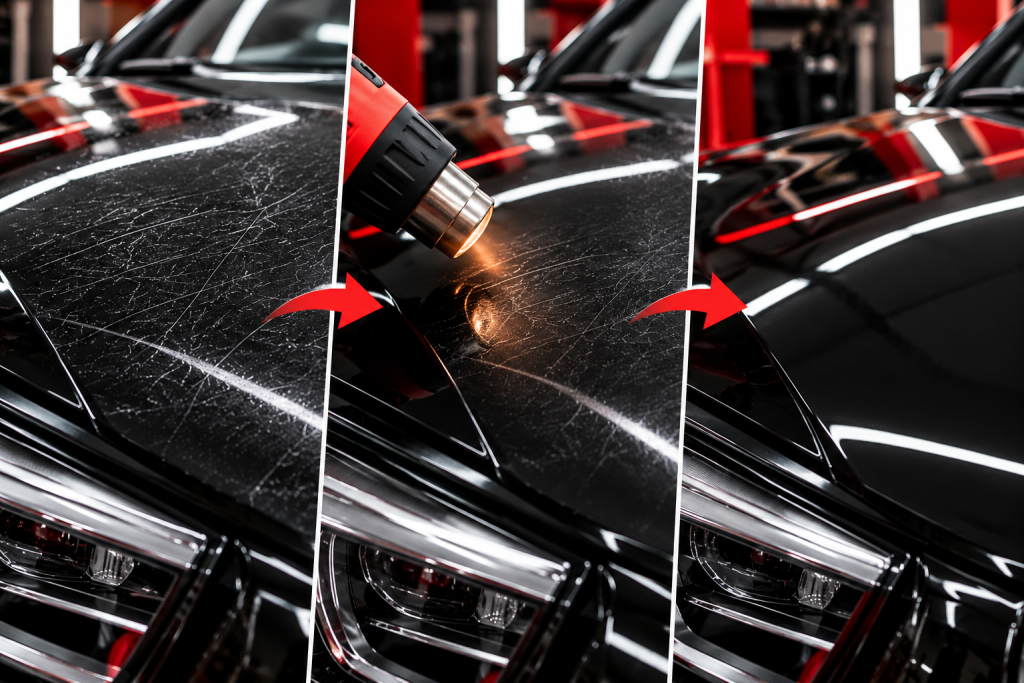
The heat source can be:
- Sunlight. A film parked in the sun on a Sharjah afternoon often heals faster than anywhere else in the world.
- Warm water. Pouring warm water over the area activates healing quickly.
- Ambient warmth. In a hot garage or after a drive, residual heat is often enough.
Healing time depends on temperature. In warm conditions, light marks can disappear within minutes, while in cooler weather it can take longer. Sharjah’s climate is close to ideal for this technology.
Why This Matters for Sharjah Drivers
Fine marks are inevitable on any car that is washed, wiped, and driven in a dusty environment. Dust, sand, and everyday contact create micro scratches and swirl marks on exposed paint, and these accumulate until the surface looks dull.
With self-healing PPF, those marks appear on the film, not the paint, and then fade away. The result is paint that stays looking new for years, with less need for polishing and correction. Combined with stone chip protection on highways like Emirates Road, it addresses the two biggest paint threats in the region.
What Self-Healing PPF Can Repair
Swirl marks. The fine circular marks from washing and wiping.
Light scratches. Marks from fingernails around door handles, bag zips, keys, and brushing past the car.
Wash marring. Marks from poor wash technique or soft brushes.
Minor surface abrasion. Light scuffs that only affect the top coat.
These are all superficial. The damage sits in the top coat, not through the film, and heat lets it recover.
What Self-Healing PPF Cannot Fix
This is where honesty matters most.
Deep scratches and cuts. If the film is sliced through, the polymer is physically separated and heat will not rejoin it.
Stone chips that penetrate the film. A heavy impact can puncture or tear the film. It will protect the paint beneath, but the film itself needs repair or replacement at that spot.
Chemical damage and staining. Bird droppings, bug residue, and harsh chemicals left too long can etch or stain the film’s surface.
Damage to the paint underneath. The film protects paint, it does not repair paint that was already damaged before installation.
Poor-quality film. Cheap film without an effective top coat will not self-heal at all, whatever the sales pitch says.
Common Problems and Challenges
The first issue is misleading marketing. Some shops label any clear film “self-healing” even when it is a low-grade product. Ask for the brand, the product line, and the warranty in writing.
The second is expecting it to fix everything. Owners who see a deep key scratch or a torn edge and expect it to vanish are disappointed. Self-healing is for light damage only.
The third is poor installation. Even the best film will lift, bubble, or show visible edges if installed carelessly. Healing cannot correct a bad install.
The fourth is bad maintenance. Wax, harsh polishes, and high-pressure washing at the edges can damage film or interfere with its properties.
Important Factors to Consider
Film brand and grade. Genuine TPU from an established manufacturer performs far better and carries a meaningful warranty.
Top coat quality. The healing ability, gloss, and stain resistance depend heavily on it.
Installer skill. Edges, curves, and cuts determine how the film looks and lasts.
Coverage. Many owners protect the highest-impact areas first, such as the bonnet, front bumper, mirrors, and fender edges.
Warranty terms. Read what is covered: yellowing, cracking, peeling, and staining, and for how long.
Your driving pattern. Highway commuters benefit most from impact protection, while city drivers benefit more from swirl-mark healing.
Best Practices and Expert Recommendations
Choose a genuine self-healing TPU film from a reputable brand and get the warranty documented. Have it installed by a specialist who works in a clean, controlled environment.
Allow the film to cure as instructed before washing, and avoid pressure-washing directly at the film’s edges. Wash with a two-bucket method and pH-neutral shampoo, and remove bird droppings and insect residue promptly.
For stubborn light marks, warm water poured over the area can help activate healing. Avoid heat guns unless a professional advises it. Many owners also add a ceramic coating on top of the film for easier cleaning and extra gloss.
How Professional PPF Installation Helps
Self-healing film is only as good as its installation. Professionals use digital pattern cutting or precise hand-cutting, apply the film with a slip solution, squeegee out moisture, heat-form around curves, and wrap edges to reduce lifting.
They also prepare the paint first, with decontamination and, where needed, correction, because film applied over defects locks them in. A skilled installer also knows which film to use on which panel, and can explain honestly what the film will and will not do.
Why Choose Alfaan Auto Care
Alfaan Auto Care installs self-healing PPF on daily drivers and prestige vehicles across Sharjah, including luxury and exotic cars that demand meticulous work. We select film suited to UAE heat and UV, and we explain what the film can and cannot repair before you commit.
Our recommendations are based on your car and your driving, so you pay for the coverage you actually need, not an upsell.
Our Service Process
- Free consultation and coverage recommendation
- Paint inspection, decontamination, and correction if needed
- Precision film cutting and fitting
- Careful installation, heat-forming, and edge finishing
- Final quality inspection
- Curing and aftercare guidance, with warranty details
Frequently Asked Questions
Does self-healing PPF really work?
Yes. Light scratches and swirl marks in the film’s top coat flatten out when warmed by sunlight or warm water. It does not repair deep cuts or paint damage underneath.
How long does self-healing PPF take to heal a scratch?
In warm conditions, light marks can disappear within minutes, though it may take longer in cooler weather or for slightly deeper marks.
Can self-healing PPF repair deep scratches?
No. If a scratch cuts through the film, heat cannot rejoin it. That section may need repair or replacement.
Does self-healing PPF work in Sharjah’s climate?
Very well. Strong sunlight and high temperatures provide the heat that activates the healing process.
Is self-healing PPF better than ceramic coating?
They do different jobs. PPF protects against chips and scratches, while ceramic coating adds gloss, UV resistance, and easy cleaning. Many owners use both.
Do all PPF films self-heal?
No. Older or low-quality films without a healing top coat do not. Always confirm the exact product and warranty.
Conclusion
Self-healing PPF is real technology that genuinely keeps paint looking fresh, particularly in a hot climate like Sharjah’s. It handles swirl marks and light scratches beautifully, but it is not magic: deep cuts, chemical damage, and poor installs are outside its limits. Choose genuine TPU film and a skilled installer, and it will reward you for years.
Get a Free PPF Consultation
Want paint that protects itself? Call Alfaan Auto Care at +971528105044 or message us on WhatsApp for a free consultation and quote.