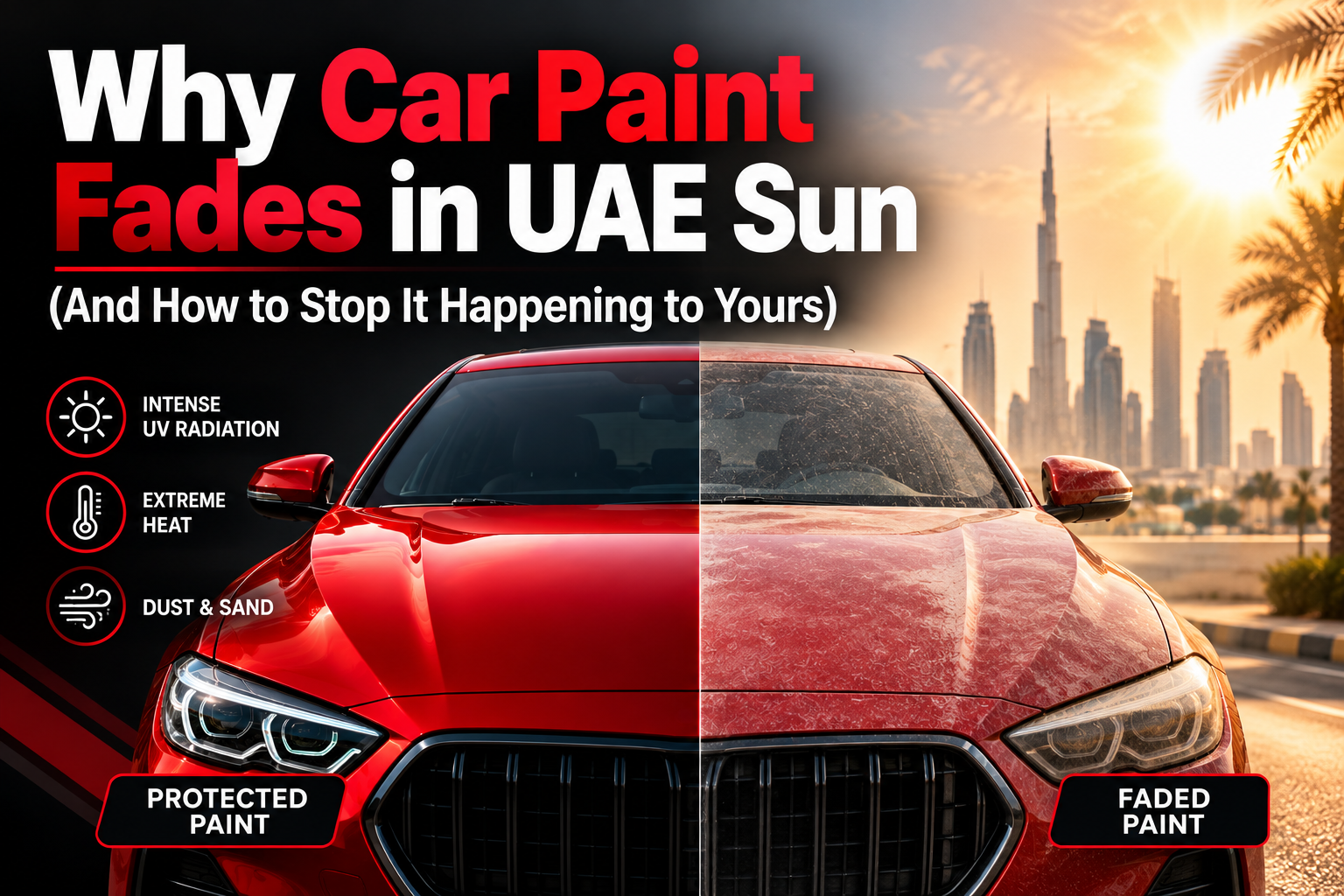
Every car owner in Sharjah has seen it: a five-year-old red car that has turned a dull, chalky pink, or a black bonnet that looks grey and lifeless while the doors still look reasonably fresh. Understanding why car paint fades in the UAE is the first step to preventing it, and the reason it happens here so much faster than in Europe or Asia has less to do with the paint itself and far more to do with what our climate does to it every single day.
Here is what is actually happening to your paint at a chemical level, and what genuinely stops it.
What Paint Fading Actually Is
Modern automotive paint is built in layers. Primer sits on the metal, the base coat carries the colour pigment, and a transparent clear coat sits on top acting as the protective shield. Nearly all “faded paint” is not the colour layer failing first, it is the clear coat breaking down and exposing the pigment underneath to direct UV radiation.
Once the clear coat degrades, ultraviolet light penetrates directly into the base coat and begins breaking apart the chemical bonds that hold the pigment together. This process, oxidation, is what produces that dull, chalky surface you can sometimes wipe onto your finger. At that point the damage is inside the paint, not on it, which is why no amount of washing or waxing brings the colour back.
Why the UAE Climate Accelerates This So Dramatically
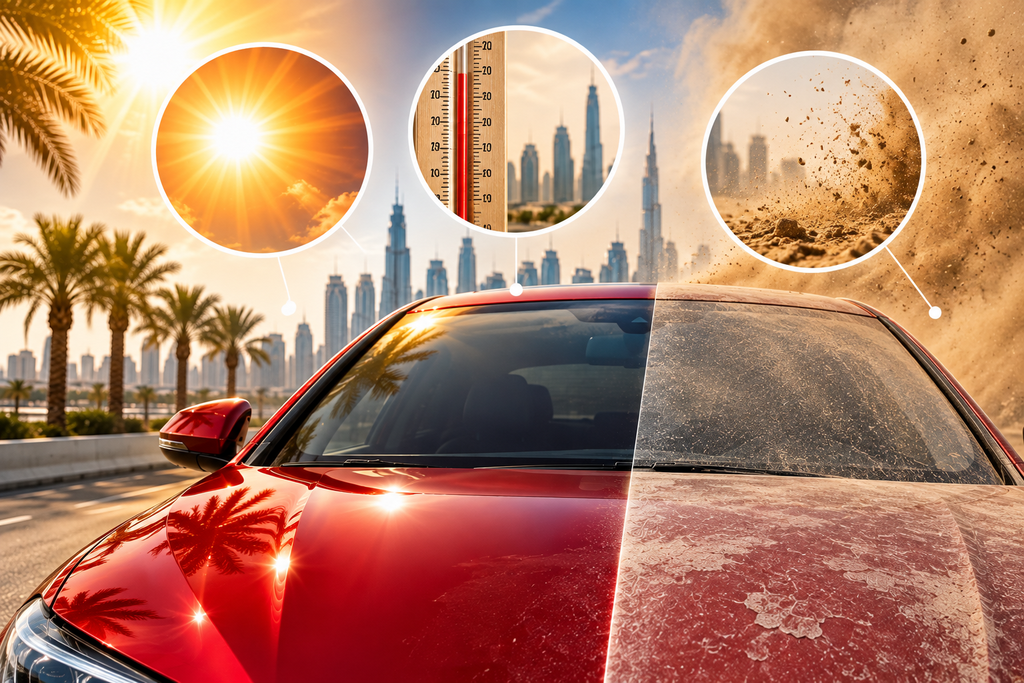
Three factors in Sharjah combine to attack paint far more aggressively than in most parts of the world.
UV intensity. The UAE receives some of the highest year-round UV index readings globally. UV radiation is the single largest driver of clear coat breakdown, and here it is intense for the majority of the year rather than a few summer months.
Surface temperature. Ambient air temperature in summer may read 45°C, but a dark car panel sitting in direct sun can reach considerably higher surface temperatures. Heat accelerates every chemical reaction involved in oxidation, effectively speeding up the ageing process of the clear coat.
Abrasive dust. Sand and dust settling on paint daily create microscopic scratching every time the surface is touched, wiped, or exposed to wind. This micro-abrasion physically thins the clear coat, reducing the very layer that is supposed to be blocking UV in the first place.
Each factor alone would be manageable. Together they create a compounding cycle: heat and UV weaken the clear coat, abrasion thins it, and a thinner clear coat lets even more UV reach the pigment.
Why Some Colours Fade Faster Than Others
Red is notoriously the fastest-fading automotive colour, and there is a genuine chemical reason for it. Red pigments historically had weaker molecular stability under UV exposure than other colours, meaning they break down sooner once the clear coat begins failing. Black absorbs significantly more heat than lighter colours, raising panel surface temperature and accelerating oxidation from the thermal side rather than the pigment side.
White and silver generally hold up longest, not because they resist UV better, but because they reflect more heat and any minor fading is far less visually obvious against a light background.
Which Panels Fade First and Why
Fading is almost never uniform across a vehicle. The bonnet, roof, and boot lid fade first because they are horizontal surfaces that receive direct overhead sun for the longest daily duration. Vertical panels like doors receive sunlight at an angle for a shorter portion of the day, which is why you often see cars where the roof and bonnet look noticeably duller than the sides.
This uneven fading is one of the clearest visual signals to a buyer that a car has been parked outdoors long-term without protection, and it directly affects resale value.
Common Mistakes That Speed Up Fading
Relying on wax as long-term protection. Traditional carnauba wax offers genuine but very short-lived UV protection, typically breaking down within weeks under Sharjah conditions. Owners who wax occasionally often believe they are protected when the wax layer is long gone.
Dry-wiping dust off the paint. This is one of the most damaging habits in the region. Dragging a dry cloth across dusty paint abrades the clear coat directly, thinning your UV barrier every single time.
Parking in the same orientation every day. A car always parked facing the same direction receives concentrated sun exposure on the same panels, producing pronounced uneven fading over years.
Assuming new paint is invulnerable. Factory clear coat begins degrading from day one of sun exposure. Waiting two or three years before considering protection means several years of avoidable damage has already occurred.
Using harsh household cleaners. Dish soap and general-purpose detergents strip any protective layer present and can accelerate clear coat degradation with repeated use.
Can Faded Paint Be Restored?
This depends entirely on how far the damage has progressed, and it is worth being honest about the limits.
If the clear coat is dulled or lightly oxidised but still intact, machine polishing can often remove the damaged surface layer and restore genuine gloss and colour depth. This is a real restoration, not a cosmetic trick, and results can be dramatic.
If the clear coat has failed completely, showing peeling, flaking, or a chalky texture that returns after washing, polishing cannot fix it. Once the protective layer is gone, the only genuine solution is repainting the affected panels. This is why catching early dulling matters so much: the window where correction works is far wider and far cheaper than the window where repainting becomes necessary.
How to Actually Prevent Paint Fading in Sharjah
Apply ceramic coating early. A quality ceramic coating adds a sacrificial UV-resistant layer bonded to the clear coat, absorbing UV exposure that would otherwise degrade the paint. It is currently the most effective long-term prevention available for daily-driven vehicles.
Use PPF on high-exposure panels. Paint protection film provides both physical and UV protection, and on the bonnet and roof, the two fastest-fading panels, it directly addresses the worst-affected areas.
Park in shade or covered parking wherever possible. This costs nothing and meaningfully reduces cumulative UV and thermal load.
Wash regularly with correct technique. Removing abrasive dust before it can thin the clear coat protects your UV barrier physically.
Get periodic professional inspection. Early oxidation is often detectable under proper inspection lighting long before it is visible in daylight, when correction is still simple and inexpensive.
How Professional Services Help
Assessing whether paint is lightly oxidised, moderately degraded, or beyond correction requires proper inspection lighting and paint thickness measurement, tools that reveal how much clear coat is actually left to work with. This matters because aggressive polishing on already-thin clear coat can push it into failure. Professional assessment determines both what your paint needs and what it can safely tolerate.
Why Choose Alfaan Auto Care
Alfaan Auto Care has restored and protected paint on hundreds of vehicles across Sharjah, from daily-driven sedans showing years of neglect to prestige vehicles being protected from day one. We measure clear coat thickness before any correction work, so we never remove more material than your paint can safely spare.
Our recommendations are based on what your specific vehicle actually needs, whether that is straightforward correction and coating, or an honest conversation about panels that have progressed past the point where polishing will help.
Our Service Process
- Free paint inspection under dedicated lighting
- Clear coat thickness measurement to determine safe correction limits
- Full decontamination wash and clay bar treatment
- Staged machine polishing to remove oxidised surface layer
- Ceramic coating or PPF application to prevent recurrence
- Aftercare guidance tailored to your parking and driving situation
Frequently Asked Questions
How long does it take for car paint to fade in the UAE? Noticeable dulling can appear within two to three years on unprotected vehicles parked outdoors, with significant fading typically visible by year four or five depending on colour and exposure.
Does colour really affect how fast paint fades? Yes. Red pigments historically break down faster under UV exposure, while black absorbs more heat and accelerates oxidation thermally. White and silver generally show fading least.
Can polishing fix faded paint permanently? Polishing removes oxidised clear coat and restores gloss, but it does not prevent recurrence. Without a protective coating applied afterwards, fading resumes from the same environmental exposure.
Is ceramic coating enough to stop fading completely? It significantly slows fading by absorbing UV exposure, but no coating makes paint permanently immune. Regular maintenance and periodic inspection remain important.
What if my clear coat is already peeling? Once the clear coat has physically failed, polishing cannot restore it. Repainting the affected panels is the only genuine solution at that stage.
Conclusion
Car paint fades in the UAE because intense UV, extreme surface temperatures, and abrasive dust attack the clear coat simultaneously, year-round. The damage is entirely preventable, but only if protection is applied before the clear coat has degraded past the point where correction still works.
Protect Your Paint Before It Fades
Noticing your bonnet or roof looking duller than the rest of the car? Call Alfaan Auto Care at +971528105044 or message us on WhatsApp for a free paint inspection and honest assessment.